


WINDOWS ARTIST INTERVIEW
Sailing along the border between order and imagination
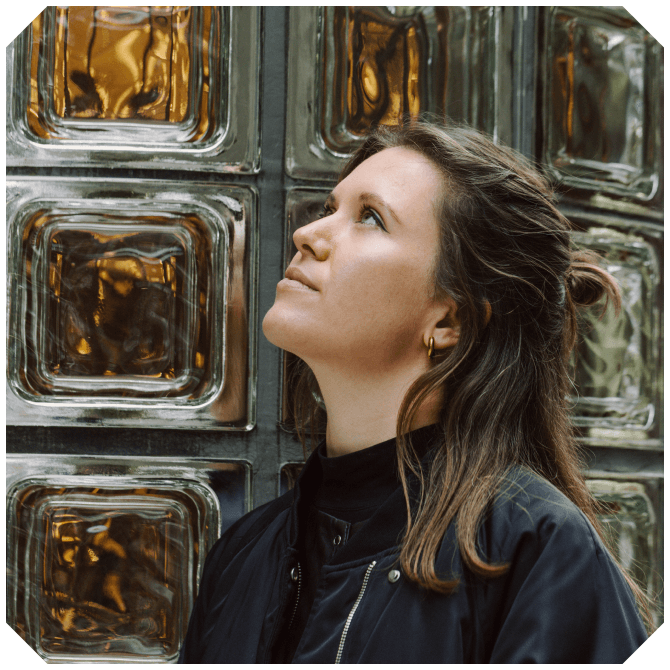
Artist
Holly Hendry
My name is Holly Hendry, and I’m an artist living in London. It’s my first professional encounter with Hermès and my first window display in Ginza, so this is very exciting for me.
Two worlds
separated by waves
This year’s Hermès theme is expressed in English as Venture beyond, but in the original French, it is L’appel du large. One of the definitions of this phrase is a call to the sea. So, the starting point for me was the sea and water. I wanted to design something that combined logic, science, and rationality with dreams and imagination, so I started focusing on wave machine devices. These were wooden slatted models that were used to visualize mechanisms of the sea and wave motion.
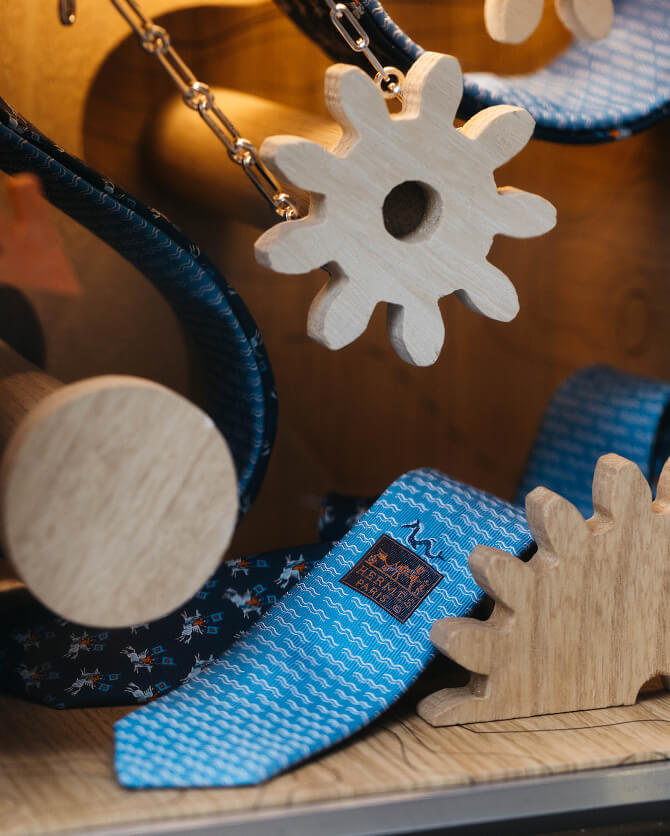
In the large windows to the right and left of the main entrance, I depicted two very different worlds separated by a boundary of waves crated by a wave machine. The world beneath the waves is a world of gears rotating in an orderly, mechanical way, while the world above is more emotional and unpredictable. In a way, it’s a reflection of our lives: we find comfort in rhythm and cycles, but we are also constantly driven by thought and emotions.
The imagination
and playfulness
of ancient sailors
If you look at the left-hand window that depicts the world beneath the waves, you’ll spot a saddle tree. You might not visually associate it with the sea, but ancient sea maps from medieval times and the Renaissance often depicted sea horses, essentially a sea version of the land horse. Before satellites and sonar, sailors used their creativity to imagine what could lie in waters that they had never visited. Applying this kind of imagination and playfulness towards exploring the unknown is something you see in Hermès as well.

Craftsmanship that
elevates the potential
of materials
Of course, the saddle itself is also very relevant to Hermès. In designing the wooden wave machine and saddle tree, I was inspired by wooden automata. What they have in common is that they are rooted in precision craft—elevating materials to their highest potential. They honour the analogue ingenuity that continues to define Hermès.

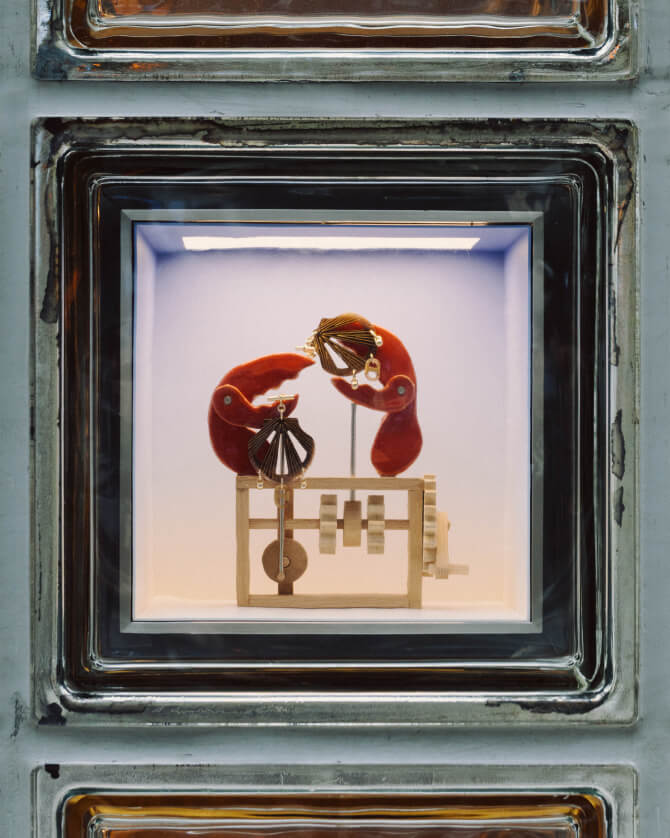
For the sixteen small window displays, I wanted them to make you feel like you’re getting a peek into my studio. I incorporated items that represent distance and exploration, such as envelopes, maps, and stationery, but I made some of them by hand using clay and metal. And then I placed Hermès objets among them. There is a Twilly silk scarf, Cheval de Coeur Bandana, tucked into a bottle like a message addressed to nobody, a postcard adorned with a Lips leather necklace, and a scroll with a Clé leather necklace tied around it, perhaps a key to a hidden treasure chest.
In my work, I often reference the film Who Framed Roger Rabbit? (1988), which features both real actors and cartoon actors who interact together. I feel like the cartoon elements make the real actors look more vulnerable and human. In my case, I wanted the imaginary elements I created to reveal the humanness of the Hermès objets.
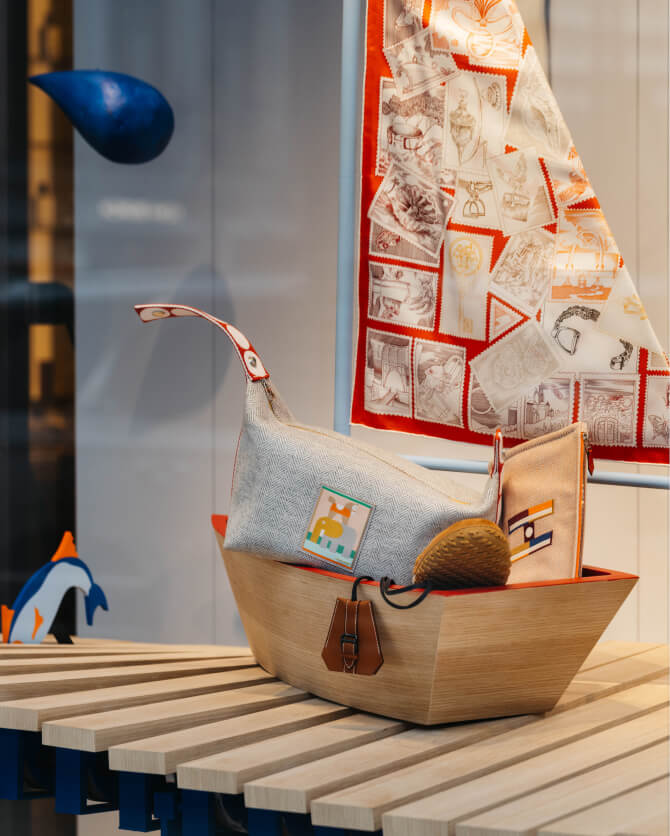
And there you have it: a ship with an Hermès carré flapping from its mast, sailing towards places unknown while riding on top of a rhythmical wave machine. I hope passersby who stop to look at the window display will be transported, for even just a moment, towards the realm of the unfamiliar.

